
A double bond as a coupling handle
Most of the lab’s later radical cross-couplings start from a carboxylic acid, a sulfone or a hydrazide. An earlier, and still distinct, line starts from something even more common: an olefin.
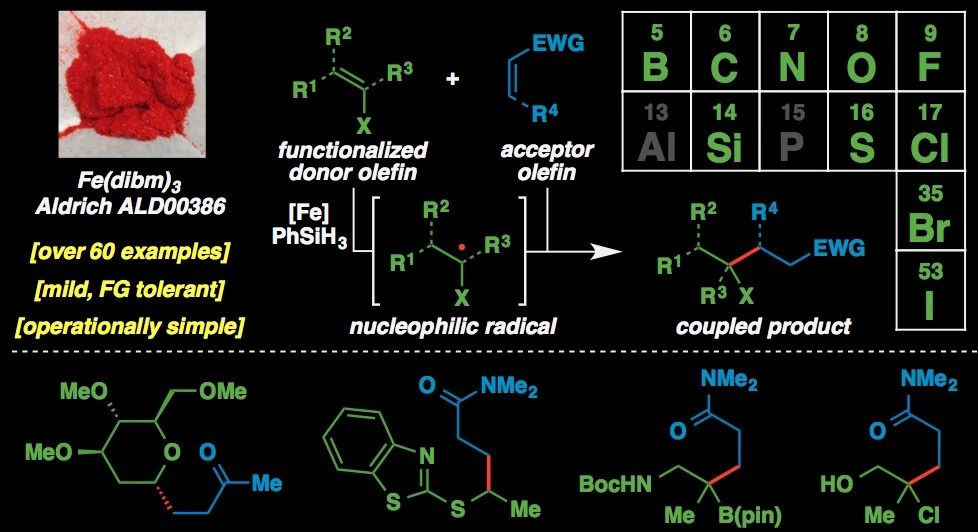
Olefins are among the most versatile, inexpensive and ubiquitous functional groups in synthesis. In 2014 the lab showed that an iron catalyst and a simple silane could couple two of them, reductively, without first converting either partner into an organometallic or an activated acid. A companion Nature paper the same year made the intermolecular, functionalized version of that idea general. The chemistry has a name now — reductive olefin coupling, or ROC — and a mechanistic pedigree in metal-hydride hydrogen-atom transfer (MHAT, often called Fe-HAT when iron is the metal). The handle is the olefin itself.
From Mukaiyama and Halpern to a general coupling
The 2014 papers did not invent hydrogen-atom transfer. As the lab’s 2026 open-access review lays out, Halpern had proposed in the 1970s that a metal hydride could transfer H• directly to an olefin, producing a carbon-centered radical. Mukaiyama later pioneered the use of mild metalloenzyme-cofactor mimics to hydrate unactivated olefins. A connection between those two lines of work was largely absent until Norton, studying carbonyl metal hydrides, noted that a cobalt-catalyzed hydroperoxidation “probably involves H• transfer.” In the years that followed, many groups — Carreira, Boger, Herzon, Shenvi, Pronin, Shigehisa and others — expanded MHAT methods to form C–X bonds, isomerize olefins, or hydrogenate them. What was slower to develop was a general way to make a carbon–carbon bond.
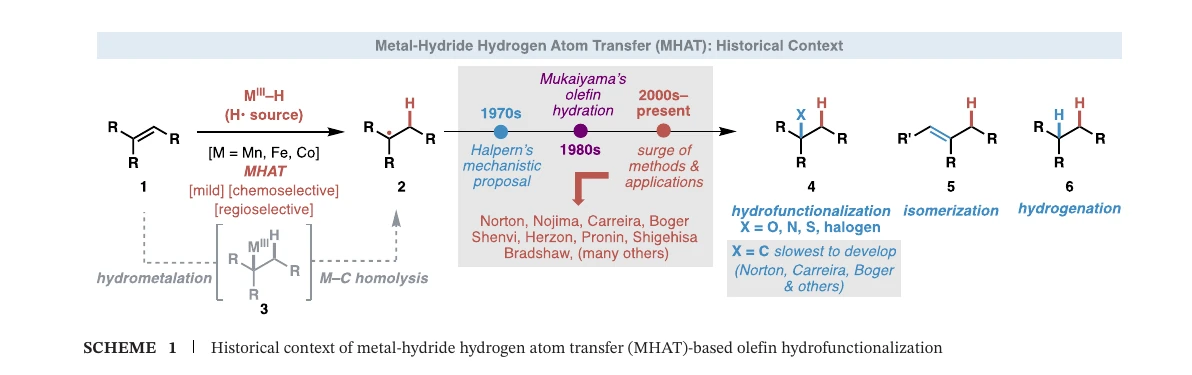
There were important earlier clues. Studies from Boger, Carreira and Shenvi had observed diene cyclization in radical-clock experiments. Van der Donk had used vitamin B12 for reductive 5-exo-trig cyclizations of dienes; Norton had used chromium and vanadium hydrides to cyclize dienes and polyenes, often relying on the Thorpe–Ingold effect; Ishibashi had coupled olefins with iron catalysts but terminated the reaction by capturing oxygen, with a limited substrate scope. The foundational discoveries, the review argues, “revealed great potential for a general C–C bond construction platform using MHAT.”
That general platform is what the 2014 work set out to provide. An intramolecular variant was inspired by a simplifying disconnection of the A-ring of terpenoid natural products such as ent-kauranes: the cyclization “clears stereocenters and simplifies sp3 carbon chains with high degrees of saturation and substitution to easily accessible dienes,” a move the review describes as strategically simplifying by Corey’s retrosynthetic logic. After a screen of iron sources, reductants and solvents, commercially available Fe(acac)3 and phenylsilane in ethanol efficiently closed the ring. Intermolecular couplings were facile despite the obvious side reactions — hydrogen-atom transfer to the acceptor, premature reduction or oxidation of intermediate radicals, oligomerization — and worked with a wide range of electron-deficient acceptors: enones, acrylates, butenolides, acrylamides, acrylonitrile, vinyl sulfones, even acridine, with little variation in the conditions. The two partners were differentiated by their electronics. The “donor” olefin was electron-neutral; the “acceptor” was electron-deficient.
An iron hydride, a radical, a Giese addition
Conceptually, reductive olefin coupling combines Mukaiyama’s olefin hydrofunctionalization with Giese’s radical addition to olefins. The mechanistic proposal, refined in the 2017 study and summarized in the review, is an iron-catalyzed hydrogen-atom-transfer cycle. In situ, Fe(acac)3 reacts with phenylsilane in ethanol to generate an Fe(III)–H species. That hydride transfers a hydrogen atom, chemoselectively, to the donor olefin, producing the more substituted carbon-centered radical — a Markovnikov-selective, irreversible, rate-determining step. The radical then adds, regioselectively, to the electron-deficient acceptor (a polarity-matched Giese addition). The adduct radical is reduced by Fe(II) to a π-stabilized carbanion, regenerating Fe(III), and the solvent protonates the anion to give the coupled product.
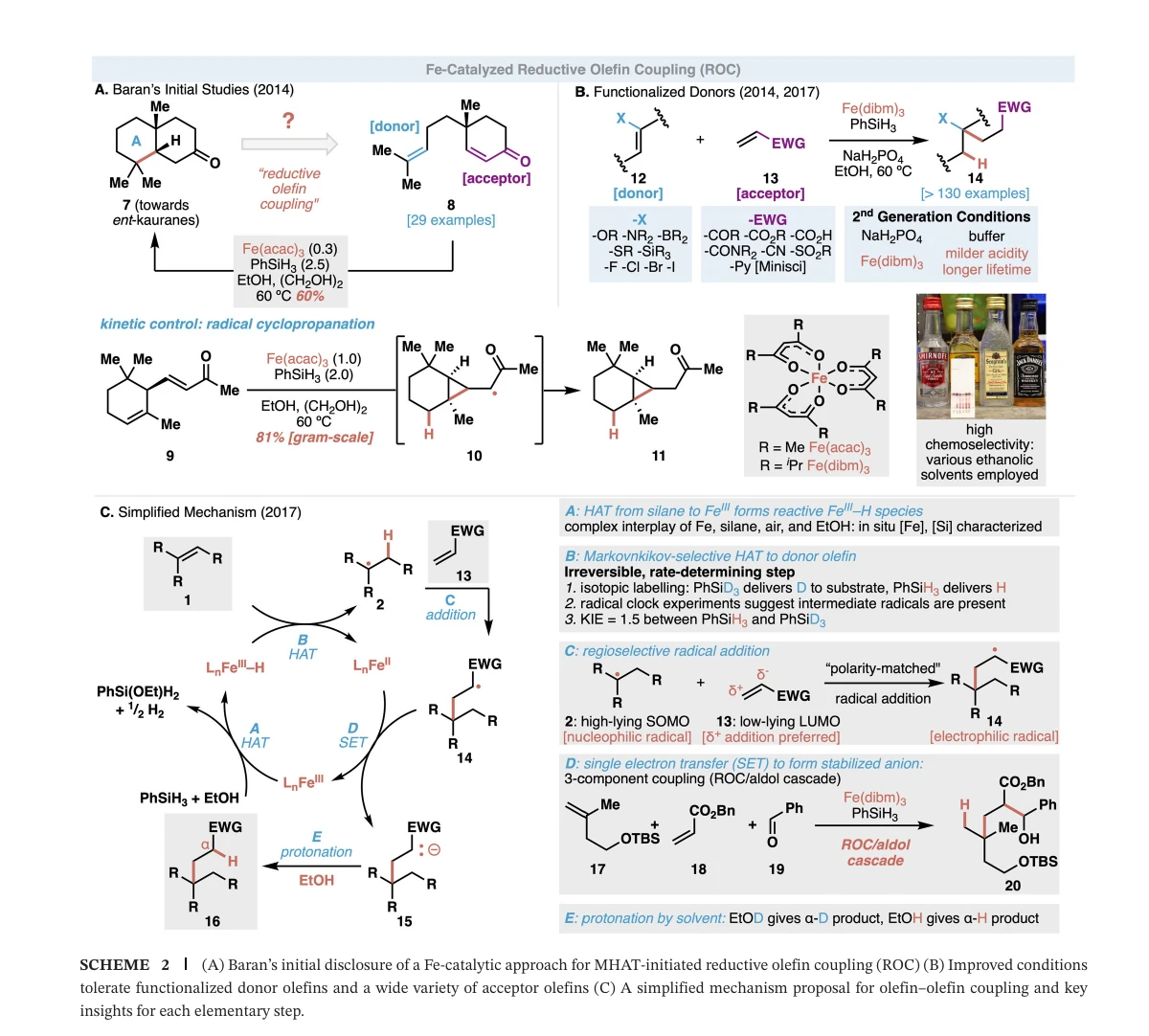
The first-generation conditions — Fe(acac)3, phenylsilane, ethanol — had a key limitation: electron-rich, heteroatom-substituted donor olefins often degraded, apparently from the Lewis or Brønsted acidity of alcoholic iron(III). A bulkier catalyst, Fe(dibm)3, hypothesized to be a weaker Lewis acid, and sodium phosphate as a Brønsted buffer, solved much of that problem. Used together, the second-generation conditions tolerated lower iron loadings, functionalized donors, and a very broad range of acceptors. As a testament to the chemoselectivity, the review notes, the reaction even tolerated commercial alcoholic spirits — beer, wine, liquor — as the solvent.
⚗ For chemists
Why the termination step matters
Traditional Giese additions often rely on toxic or expensive hydride sources to terminate the radical chain, and earlier iron-initiated olefin/olefin couplings (terminated by trapping with oxygen) were limited by reversibility or a lack of polarity matching. In this platform the more electron-deficient radical is reduced by Fe(II), which selectively traps the adduct even when cyclization is reversible or thermodynamically disfavored — the review’s example is a radical cyclopropanation that holds, despite a well-known radical-clock ring opening that would otherwise undo the new ring. That kinetic regime is part of what makes the method useful in complex settings.
A one-electron cut where a polar route would wander
The same planning idea runs through the 2018 Account on radical retrosynthesis: a one-electron disconnection can replace a polar sequence that would have required prefunctionalization, cryogenic organometallics, or a later, unselective reduction. The 2026 review draws that contrast for reductive olefin coupling itself. A decalone that might have been built by a Robinson annulation and a hydrogenation can instead be disconnected at the A-ring and closed by an intramolecular ROC from a simple diene. A hydroalkylation that might have gone through a cyclopropanation and a forcing hydrogenolysis can be done, instead, by coupling to a vinyl sulfone and desulfurizing. Polar conjugate addition suffers from extra steps and sensitive intermediates; the nucleophilic radicals generated by ROC are already primed for a mild conjugate addition.
That is the sense in which the method is a tool of radical retrosynthesis, not only a new reaction: one cuts a C–C bond that a hydrogen-atom transfer can make, then chooses an ordinary olefin as the donor. For the broader logic — innate versus programmed couplings, and the lab’s ideality metric — see radical retrosynthesis: the logic. For couplings that start from acids, sulfones or hydrazides, see radical retrosynthesis: cross-coupling.
Two case studies: a methyl group, and a vitamin D analog
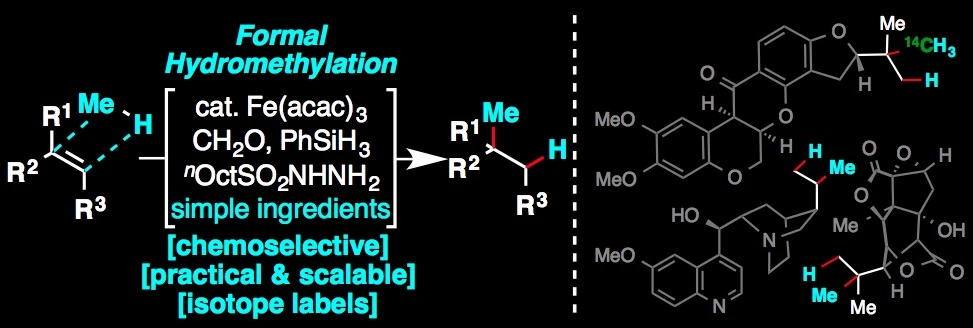
The method was put to work in the lab almost immediately. In 2015, a formaldehyde hydrazone was used as the radical acceptor: after the iron-catalyzed addition, the sulfonyl hydrazide adduct was degraded in the same pot, with base, to unveil a latent methyl group. The reaction was general enough for late-stage diversification of natural-product scaffolds, including isotope labelling. Trimethyl borate was a critical additive for improving the reaction. It is a formal hydromethylation of an unactivated olefin — a transform that is simple to write and historically awkward to carry out.
A later, intramolecular example comes from the 2022 synthesis of (+)-calcipotriol and a modular series of vitamin D analogs. A 5-exo-trig ROC was used to form the hydrindane C/D ring. The route began from a cyclohexenone, elaborated in five steps to an acid; an electrochemical decarboxylative alkenylation then set the stage for the cyclization. Fe(acac)3 gave the cis-fused hydrindane in 38% yield; Fe(dpm)3 was superior, delivering 47% as a single diastereomer. A more reactive silane, PhSi(OiPr)H2, was necessary for any product to form. A nine-step sequence then converted that bicycle into the vitamin D skeleton, including (+)-calcipotriol, by a semi-pinacol rearrangement to set the trans-hydrindane stereochemistry, a Sonogashira/hydrogenation approach to a convergent triene, and a divergent decarboxylative arylation that, from a methyl ester placed after the ROC, gave access to 12 vitamin D analogs.
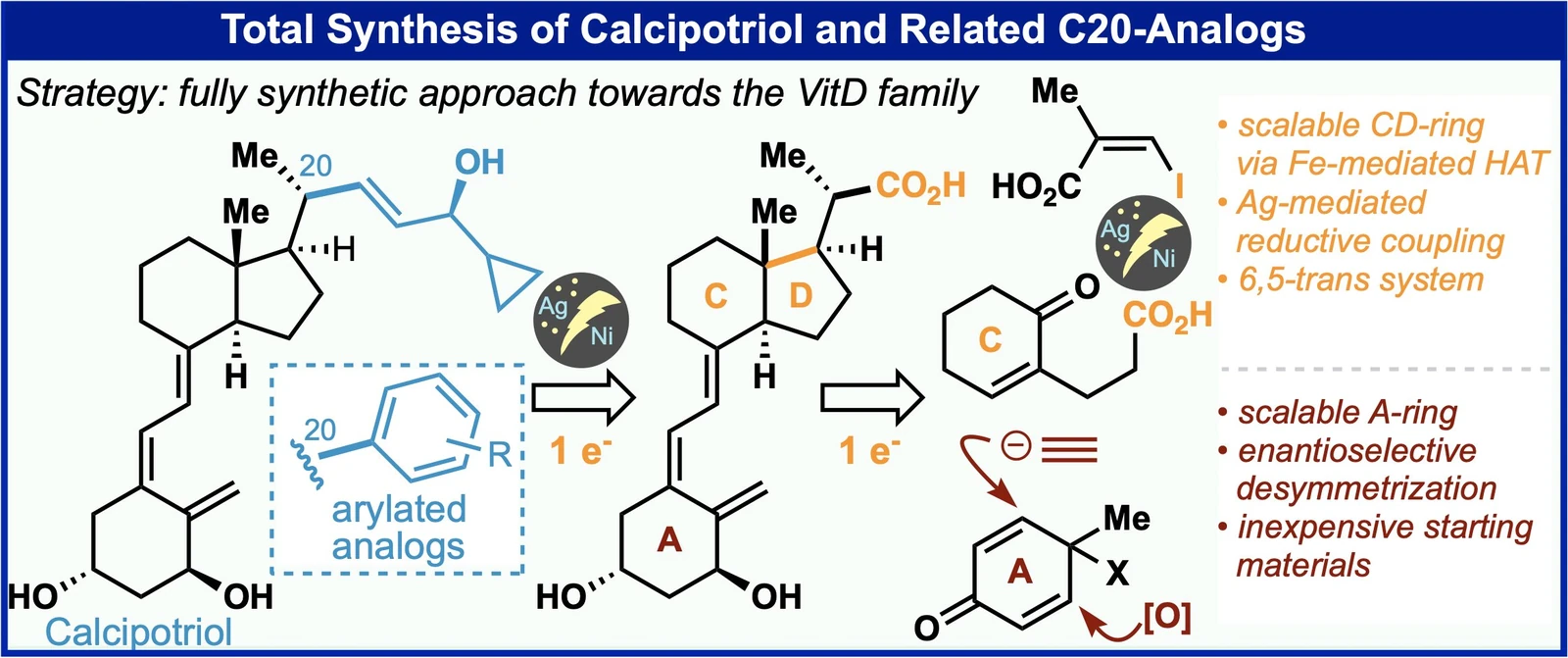
A 2026 communication from the lab takes a related idea further, with a convergent radical annulation designed for terpenoid synthesis.
Dozens of natural products, many hands
The distinctive claim of the 2026 review is not that the lab made all of these molecules. It is that, since the 2014 disclosure, the method has been used in dozens of strategic total syntheses, across terpenoids, alkaloids and polyketides, by many groups. The review surveys those routes — intermolecular couplings, five- and six-membered ring closures, bridging rings, cascades with aldol or Dowd–Beckwith rearrangements, and variants that use nitriles or carbonyls as the acceptor instead of an olefin — and it is careful to credit the chemists who actually built each target.
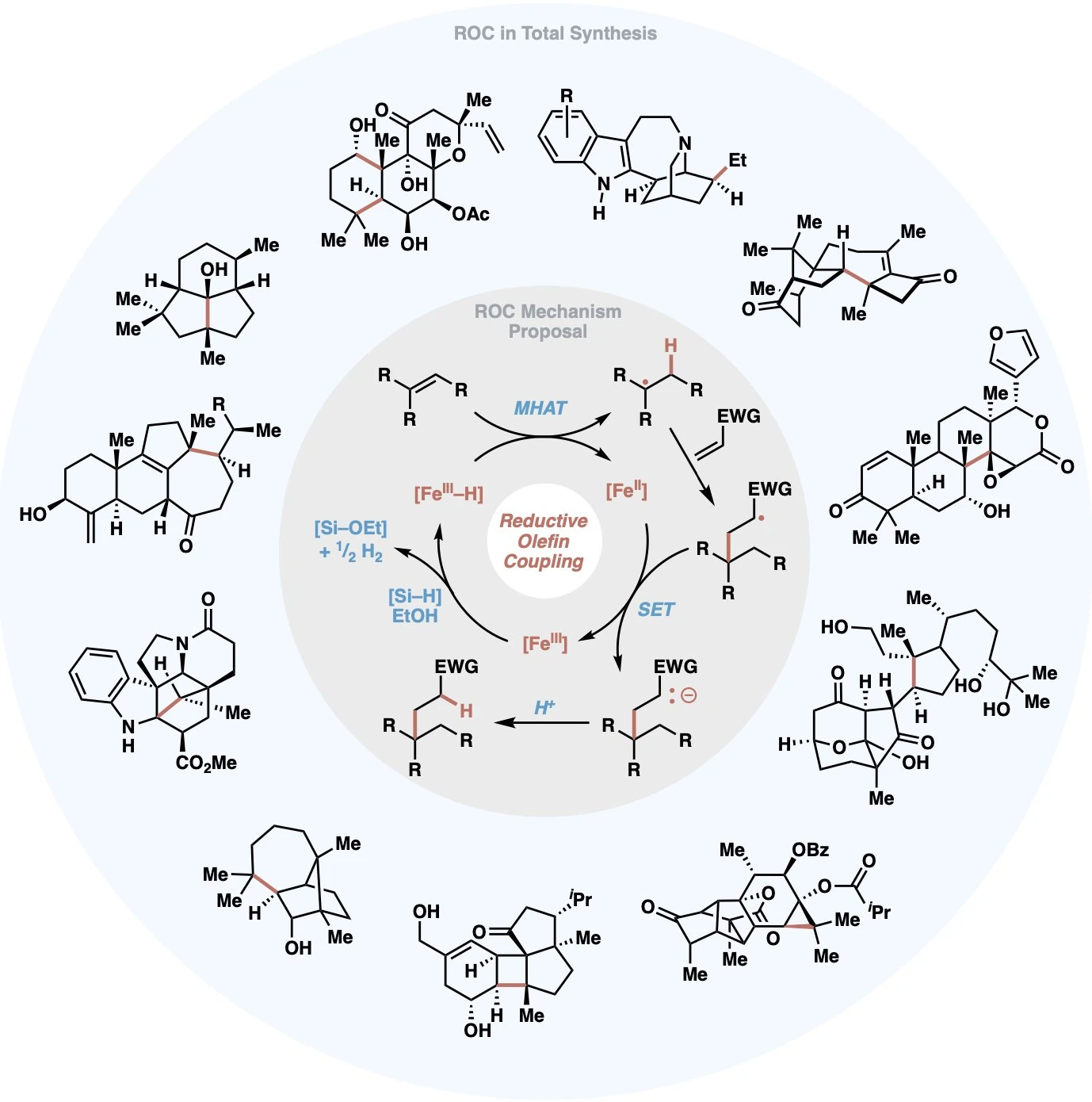
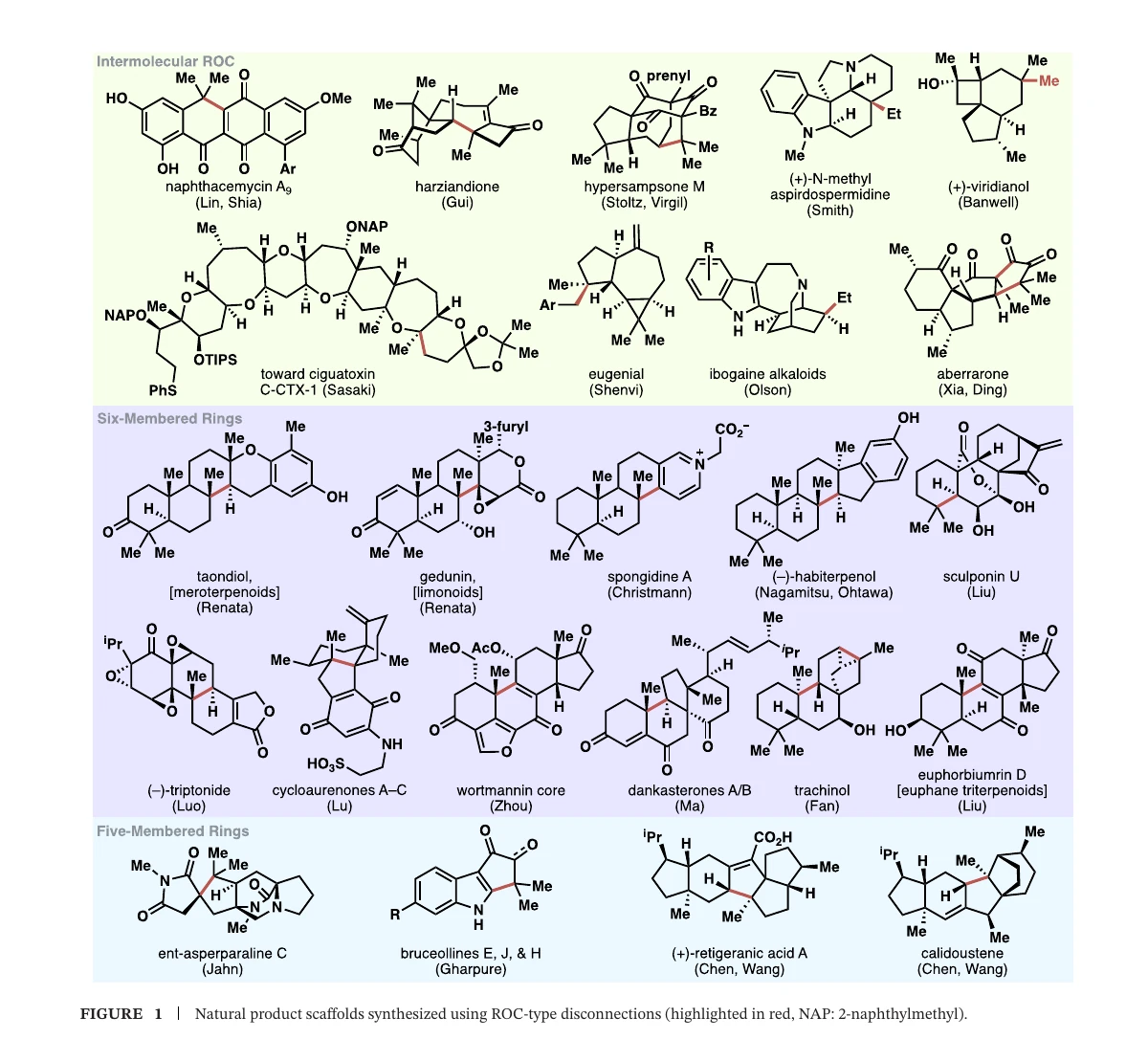
A few examples give the flavor, without pretending the list is complete. Sarpong used an intermolecular ROC of an isopropene donor, from (R)-carvone, with methyl acrylate, then a Dieckmann condensation, to reach an oxidized decalin that maps onto oxygenated terpenoids. Lin and Shia coupled styrenes to methyl acrylate and closed the ring by a Friedel–Crafts acylation en route to tetracyclic antibiotics, including naphthacemycin A9. Sasaki’s late-stage coupling of a complex alkenyl ether with a siloxyenone, buffered by di-tert-butylpyridine, advanced the H–N rings of ciguatoxin C-CTX-1. Stoltz and Virgil installed a latent aldehyde in the first step of a synthesis of hypersampsone M; Pronin has used the reaction, and ROC/aldol cascades, in approaches to forskolin, emindole SB, nodulisporic acid C and quassin; Chen and Wang closed the five-membered ring of retigeranic acid A. The review also covers olefin–nitrile and olefin–carbonyl couplings, and cascade sequences in which the radical adduct is intercepted by an aldol or a Dowd–Beckwith rearrangement.
The review ends with practical help: a retrosynthetic blueprint for choosing a reductive-olefin-coupling disconnection, a survey of the different radical acceptors that work, and a troubleshooting guide for reaction optimization. Those sections are there for chemists who want to try the reaction, not only to read about it. For how this chemistry shows up among the lab’s own total syntheses, see the total synthesis deep dive.
 The logicThinking in radicals
 Cross-couplingDeleting redox
 ElectrochemistryThe electron as a reagent
 Total synthesisProving ground
 ReagentsReagents in a bottle
 OligonucleotidesRewriting the backbone
 PeptidesRewriting the peptide
 C–H functionalizationC–H logic