
A language for C–H bonds
A carbon–hydrogen bond is the most ordinary thing in organic chemistry, and the hardest to treat as a functional group. There are usually many of them, they look much the same, and for most of the twentieth century a synthesis was planned as if they were scenery. The lab’s wager was that they are not scenery: that if you can hear which C–H bond wants to react, and which one can be talked into reacting, you can delete the prefunctionalization that used to fill a route with concession steps.
“If C–H bonds could talk, what stories would they tell?”
That sentence is the title question of Timothy Newhouse and Phil Baran’s 2011 minireview, “If C–H Bonds Could Talk: Selective C–H Bond Oxidation”. Most writing on C–H oxidation, they noted, is organized around the reagent. Their essay is organized around the substrate: inductive effects, conjugation, hyperconjugation, steric hindrance and strain release — the stories a given C–H bond would tell if you asked it why it, and not its neighbor, was the one that reacted. The point was not a catalogue of oxidants. It was to make C–H oxidation something you could put in a retrosynthetic plan.
The same year, Will Gutekunst and Baran set the same idea in the language of total synthesis. Their Chemical Society Reviews critical review, “C–H functionalization logic in total synthesis,” is built from case studies, historical and modern, including the lab’s own. They quote Albert Eschenmoser, from 2010: “C–H activation is at the center of organic chemistry.” The review is careful about what counts. Friedel–Crafts and enolate chemistry are formally C–H disconnections; the essay restricts itself to C–H bonds “not typically viewed as being highly reactive.” The prize is economy: if one of the reacting groups is already a C–H bond, you do not have to install a functional group just so you can use it.
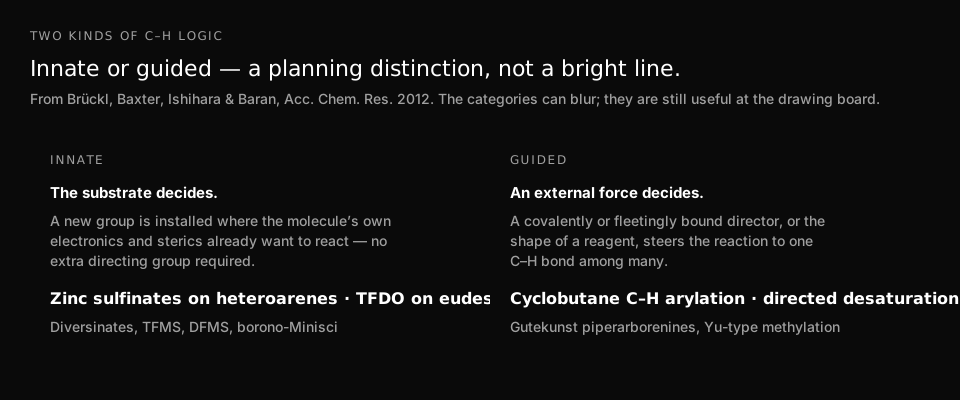
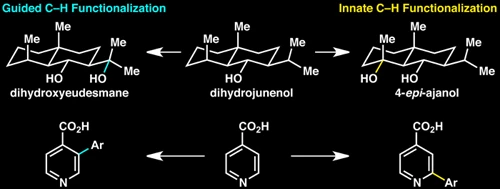
That vocabulary is from Brückl, Baxter, Ishihara and Baran’s 2012 Accounts paper, “Innate and Guided C–H Functionalization Logic.” The Account traces the lab’s own work through those two lenses: innate couplings of heterocycles and carbonyls; guided and innate oxidations used together on a family of terpenes; a chemoselective innate C–H protocol forced by nitrogen-rich alkaloids; and then a series of innate C–C bond-forming reactions aimed at medicinal chemists. The last line states the thesis: “Strategic use of C–H functionalization logic can have a dramatically positive effect on the efficiency of synthesis, whether guided or innate.”
Cyclase, then oxidase
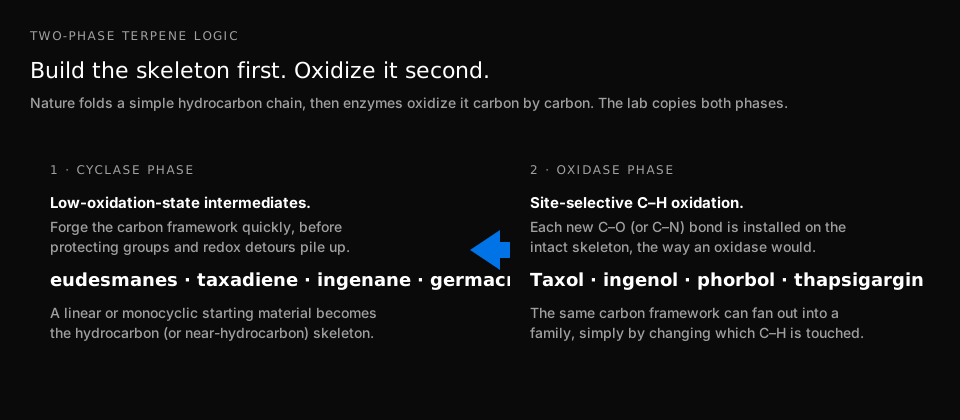
Terpenes are the largest family of natural products, and nature makes most of them in two moves. Cyclase enzymes first fold a simple hydrocarbon phosphate into a carbon skeleton. Oxidase enzymes then oxidize that skeleton, carbon by carbon, into the dizzying oxidation patterns that make one eudesmane, taxane or ingenane different from the next. The lab’s two-phase synthesis is a chemist’s copy of that choreography: build the framework while it is still lightly oxidized, then install oxygen with selective C–H reactions.
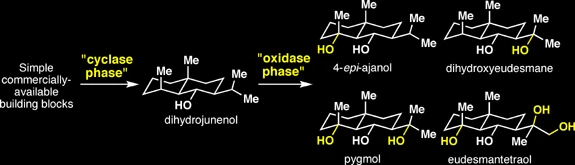
The proof of principle was a family, not a single target. In 2009, Chen and Baran reported the total synthesis of eudesmane terpenes by site-selective C–H oxidations. The eudesmane family has about a thousand members; the lab chose dihydrojunenol, one of the lowest-oxidized, as a cyclase-phase endpoint, and from there reached four more-oxidized members — 4-epiajanol, dihydroxyeudesmane, pygmol and eudesmantetraol — by C–H oxidation. A key TFDO (methyl(trifluoromethyl)dioxirane) oxidation of a tertiary C–H bond delivered an alcohol in 82% isolated yield on a gram scale — site-selectivity so striking that it later became the question behind the strain-release paper with Eschenmoser. The 2009 communication assembled dihydrojunenol in nine steps (8% overall) as a separable mixture of three stereoisomers; the 2010 Tetrahedron full account of the cyclase phase improved that to a nine-step, gram-scale, enantioselective route in 21% overall yield, with excellent stereocontrol, from cheap (<$1/g) starting materials.
Yoshihiro Ishihara and Baran’s 2010 Synlett account, “Two-Phase Terpene Total Synthesis: Historical Perspective and Application to the Taxol Problem,” put the eudesmane work in a longer frame and, already, pointed at Taxol. The oxidase-phase tools were still incomplete; the plan was on the table. Around the same time the lab also asked what a cyclase phase looks like when the ring itself is the problem. Holte, Götz and Baran’s 2012 JOC paper used nickel-promoted diene/alkyne cooligomerization as a way to mimic a sesquiterpene cyclase. Foo, Usui, Götz, Werner, Holte and Baran then reported a scalable, enantioselective synthesis of germacrenes and related sesquiterpenes “inspired by terpene cyclase phase logic,” including a direct ring closure to a ten-membered carbocycle and onward routes into guaiane, cadinane, selinane and elemene frameworks. (The germacrene carbon skeleton is famously unstable; that was the point of treating cyclization as its own phase.)
From a plan to Taxol
Taxol — paclitaxel to the pharmacist — is, in the lab’s own later wording, “widely regarded as among the most famed natural isolates ever discovered.” It is also a stress test for two-phase logic: a densely oxygenated 6-8-6 taxane, historically made, when it was made at all, by long sequences that delivered milligrams. The 2010 Synlett account had already named it as the problem. It took the rest of the decade to finish the job.
In 2012, Mendoza, Ishihara and Baran reported a scalable, enantioselective entry to the taxanes through a concise preparation of (+)-taxa-4(5),11(12)-dien-2-one, a cyclase-phase waystation with a handle for further oxidation. The route gave a gram-scale preparation of the parent hydrocarbon taxadiene — at the time, the largest quantity of that natural terpene ever isolated or prepared in pure form. Asymmetry came from an enantioselective conjugate addition that set an all-carbon quaternary center, “from which all other stereocentres are fixed through substrate control.” A vicinal difunctionalization / Diels–Alder sequence then forged the characteristic 6-8-6 tricycle, bridgehead alkene included. The 2013 Tetrahedron full paper is the cyclase-phase account of that taxane work.
Wilde, Isomura, Mendoza and Baran, in 2014, used two-phase logic to reach (−)-taxuyunnanine D. In 2016 a short, enantioselective route arrived at highly oxidized taxanes. Each paper was a rehearsal for the oxygenation pattern of Taxol itself.
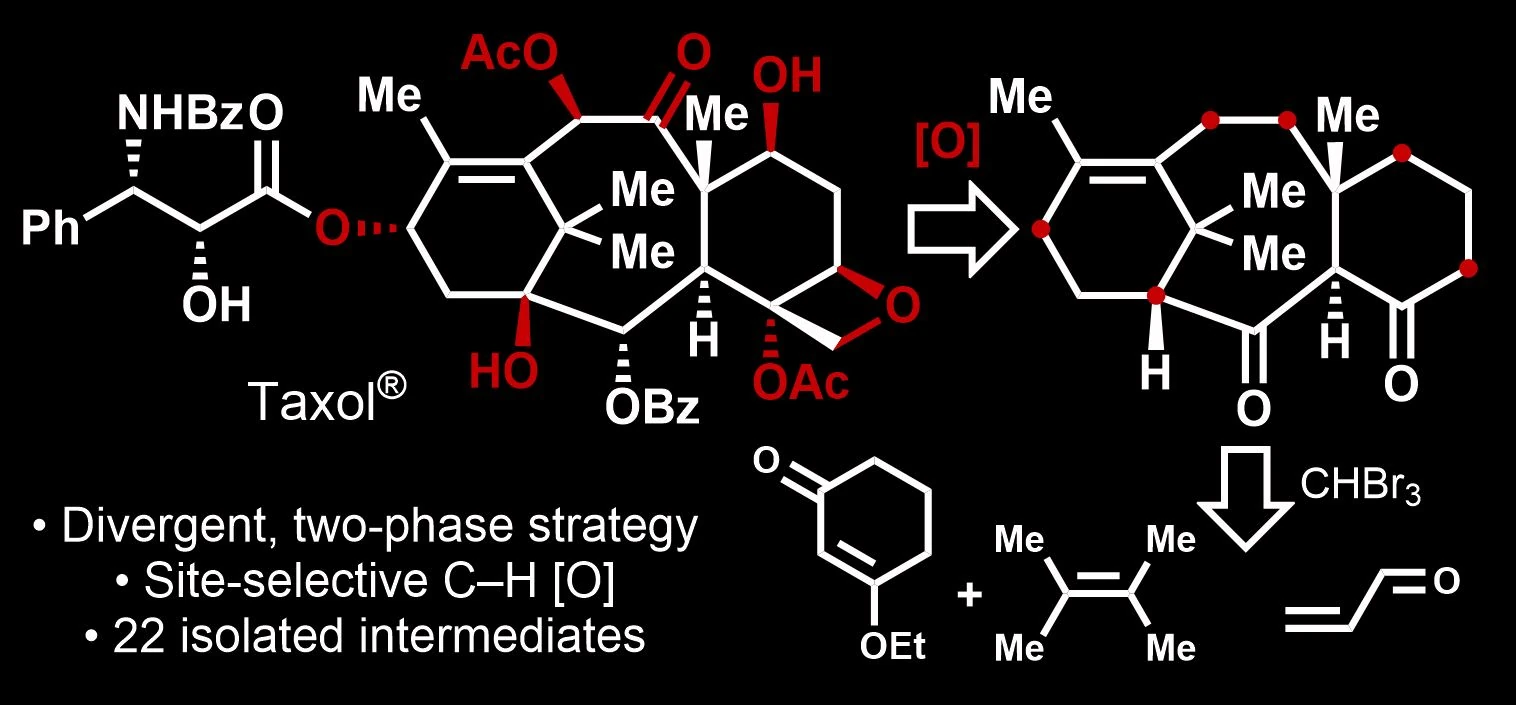
Kanda, Nakamura, Morita, Kawamura, Wada, Chen, Ishihara, Yokokawa and Baran closed the book in 2020: a two-phase synthesis of Taxol itself. The paper is explicit that those pioneering laboratory syntheses “proved the feasibility of retrosynthetically guided access to synthetic Taxol, albeit in minute quantities and with enormous effort,” and that “all medicinal chemistry efforts and eventual commercialization have relied upon natural (plant material) or biosynthetically derived (synthetic biology) supplies.” The point of the two-phase route was different. It showed that a synthesis “holistically patterned off of biosynthetic machinery for terpene synthesis” — cyclase phase, then oxidase phase — can arrive at Taxol, and that it can do so “through the isolation and purification of 22 intermediates.” A companion JOC Account the same year, “Two-Phase Total Synthesis of Taxanes: Tactics and Strategies,” is the lab’s own reading of what those tactics were, and which ones were worth keeping.
⚗ For chemists
What “22 intermediates” means
The 2020 Taxol paper counts isolated, purified intermediates along the route, not a raw transformation count. That is the number on the graphical abstract. The oxidase-phase choreography — which C–H bond is oxidized, and in what order — is the strategic heart of the work. As the authors put it, once the carbon skeleton is built early, “all oxidase phase reactions are essentially a late-stage functionalization of a complex natural product.”
Fourteen steps, then nineteen
If Taxol was the long campaign, ingenol was the sudden proof that two-phase logic could shrink a famous diterpene into a short, scalable sequence from a cheap monoterpene. Jørgensen, McKerrall, Kuttruff, Ungeheuer, Felding and Baran’s 2013 Science paper delivered (+)-ingenol in 14 steps from (+)-3-carene. Ingenol had a practical shadow: ingenol mebutate, then being used (and in limited supply) as a topical treatment for actinic keratosis, was sourced by isolation or by semisynthesis from the natural product. The paper is about a synthesis that could, in principle, address that supply problem and also open analogues that isolation cannot easily provide. A 2014 JACS paper is the development account of that concise route.
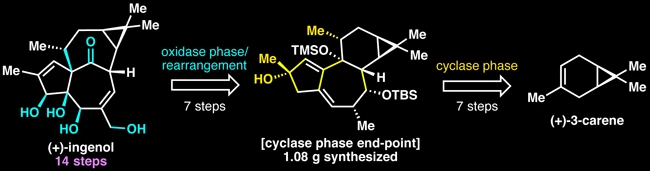
The oxidase phase did not stop at the natural product. In 2015, C–H oxidation of ingenanes was used to prepare derivatives with oxidation patterns that semisynthesis from natural ingenol cannot reach, and to ask a more precise biological question about protein kinase C. Previous work had suggested a tight link between PKCδ activation and neutrophil oxidative burst; this study found that PKCβII activation was the more important correlate, and that the core could be tuned toward isoform selectivity — dampening or even removing PKCδ-driven keratinocyte activation while retaining PKCβII-driven effects. (A later 2017 chemical-proteomics paper went looking for a functional target of the ingenol class in a different way; that biology follow-up is not a C–H paper, and it is only mentioned here because it sits downstream of the same molecule.)
Phorbol, the flagship tigliane, is a close cousin and a harder oxygenation puzzle. Kawamura, Chu, Felding and Baran’s 2016 Nature paper reached (+)-phorbol in 19 steps, again from (+)-3-carene, by two-phase logic. The authors are careful about what the synthesis is for: not to displace isolation or semisynthesis as a source of phorbol itself, but to enable analogues “containing unique placements of oxygen atoms that are otherwise inaccessible.” A Mukaiyama hydration installed the C4 oxygen on a gram scale (70% yield, with in situ silyl protection); a methylene C–H oxidation, chosen with help from computation, addressed C12 in the presence of an enone, six tertiary C–H bonds and two competing methylenes — a textbook oxidase-phase decision.
Relays, meroterpenes and a plant toxin
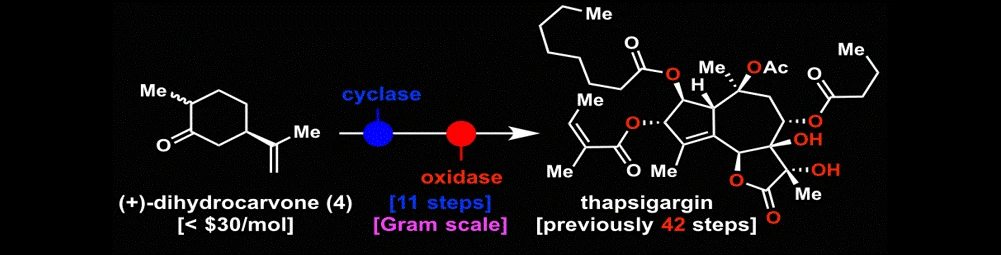
Two-phase thinking did not stay inside eudesmanes, taxanes and ingenanes. Thapsigargin, a densely oxygenated guaianolide and a potent SERCA-pump inhibitor, had been made before in 36–42-step processes. Chu, Smith, Felding and Baran’s 2017 ACS Central Science paper recast it as a two-phase problem and reported a concise, scalable synthesis of (−)-thapsigargin — 11 steps in one reported sequence (0.137% overall), plus an alternative 14-step path — and a 10-step synthesis of (−)-nortrilobolide, featuring a classic photosantonin rearrangement and a single-step construction of the carbon framework. A 2018 Bioorganic & Medicinal Chemistry Letters paper then used that platform for a divergent synthesis of three related natural products — thapsivillosin F, thapsigarcin and thapsivillosin C — and four analogs, all from a common building block that had already been prepared in greater than 30-gram batches, with the acyl chains at C2, C3 and C8 varied on purpose. Three of the analogs (those without the epimerization-prone C3-angelate) showed SERCA-inhibitory potency comparable to thapsigargin itself, which the authors flag as attractive starting points; a fourth was about tenfold less potent.
Ouabagenin, a polyhydroxylated cardenolide, sits a little to one side: it is a steroid, and the logic is a redox- and stereochemical relay rather than a terpene cyclase/oxidase pair. Renata, Zhou and Baran’s 2013 Science paper, “Strategic Redox Relay Enables A Scalable Synthesis of Ouabagenin,” described the first scalable route to a polyhydroxylated steroid, with useful quantities (500 mg–1 g) of a key precursor and, eventually, ouabagenin itself, plus new methods for C–H and C–C activation and C–O bond homolysis. The 2015 JACS development paper expands that route and takes it toward hydroxylated corticosteroid analogues. It is two-phase-adjacent — a planned oxidation pattern on a polycyclic framework — which is why it belongs in this story even if no cyclase enzyme is being imitated.
The same decade produced a cluster of C–H-enabled meroterpenes and polyoxygenated steroids. Dixon, Lockner, Zhou and Baran’s 2012 “borono-sclareolide” is a scalable, divergent meroterpenoid platform. Rosen, Simke, Thuy-Boun, Dixon, Yu and Baran then used C–H functionalization logic, including a ligand-accelerated C–H methylation, to make (+)-hongoquercin A and a small library of related compounds — a collaboration that also shows Yu-type guided methylation inside a Baran total synthesis. See, Herrmann, Aihara and Baran’s 2015 copper-mediated C–H oxidation addressed a classic steroid problem, C12 oxygenation, and applied it to polyoxypregnanes. A 2017 JOC paper with the Garcia-Bosch group decoded the mechanism of that intramolecular, copper-directed hydroxylation of unactivated sp3 C–H bonds. The study overhauls the earlier Cu2O2 picture: a mononuclear LCuII(OOR) intermediate undergoes homolytic O–O cleavage, and the resulting RO• does the C–H hydroxylation inside the solvent cage. That reading let them recast the protocol — inexpensive CuII, hydrogen peroxide, no external reductant, open flask, room temperature — and reach 70–93% yields on steroidal substrates, including a gram-scale run (1.22 g, 80%).
Strain release, with Albert Eschenmoser
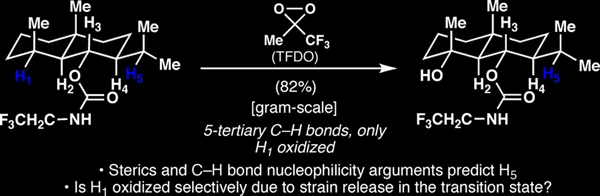
The eudesmane oxidase phase left a puzzle. Among five tertiary C–H bonds in a dihydrojunenol derivative, TFDO chose one, in 82% yield on a gram scale — not the isopropyl methine that a naïve reading of 13C shifts or sterics might have picked. Chen, Eschenmoser and Baran’s 2009 communication, “Strain Release in C–H Bond Activation?,” is the lab’s attempt, with Albert Eschenmoser, to ask why equatorial tertiary C–H bonds so often outrun their axial partners, across reagent classes.
“The work presented here may aid in the planning and execution of total syntheses that rely on the simplifying power of C–H activation logic.”
⚗ For chemists
What the probe actually showed
Eschenmoser had invoked strain release in 1955 to explain why equatorial steroidal alcohols are oxidized faster than axial ones by chromic acid (a relief of 1,3-diaxial interactions as the carbon goes from sp3 toward sp2). The 2009 paper asks whether a similar factor operates in electrophilic tertiary C–H hydroxylation, where the carbon remains tetrahedral in the product but the transition state is thought to flatten. The probe was demethyl dihydrojunenol carbamate, designed so that electronics and the steric environment at the reacting site are nearly identical to the parent eudesmane, while the 1,3-diaxial methyl–methyl clash is gone. In competition experiments, TFDO gave a 3.0–3.1:1 ratio of the two tertiary alcohols; ozone gave 3.9–4.1:1 (roughly 0.6 kcal mol−1 in ΔG‡). The authors treat those modest ratios as significant for this mechanism, by analogy with classical solvolysis. For methylene C–H activation on 1,1-dimethylcyclohexane, by contrast, they title the scheme “Strain release is a minor factor,” with little site specificity after a statistical correction (TFDO and carbene ~1:1; nitrene ~1.5:1). In more complex settings such as sclareolide, they suggest the factor may still help a chemist predict which methylene will react. The closing list of cooperating influences is careful, not triumphant: C–H bond nucleophilicity, steric hindrance to reagent approach, and strain release in the transition state.
The strain-release paper sits in a cluster of early C–H methods that are easy to miss if one only reads the terpene campaigns. In 2008, a radical-mediated C–H functionalization was already being used to stitch 1,3-diols. Luzung, Lewis and Baran’s 2009 Angewandte paper reported a direct, chemoselective N-tert-prenylation of indoles by C–H functionalization — an intermolecular allylic C–N bond, inspired by a failed campaign toward the stephacidin family of indole alkaloids. A 2012 intermolecular Ritter-type C–H amination of unactivated sp3 carbons added a nitrogen-installing oxidase-phase tool. In 2014, Michaudel, Journot, Houk, Baran and co-workers showed that chemical and enzymatic C–H oxidation can be used not only to finish a natural product, but to improve the physical properties of a lead — a reminder that oxidase-phase logic has a life in medicinal chemistry too.
Gutekunst, maximiscin, and a guided desaturation
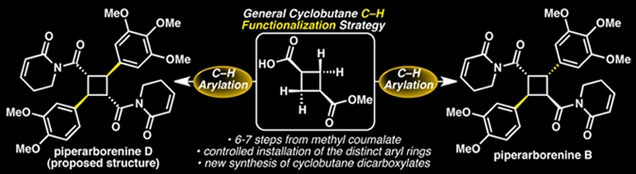
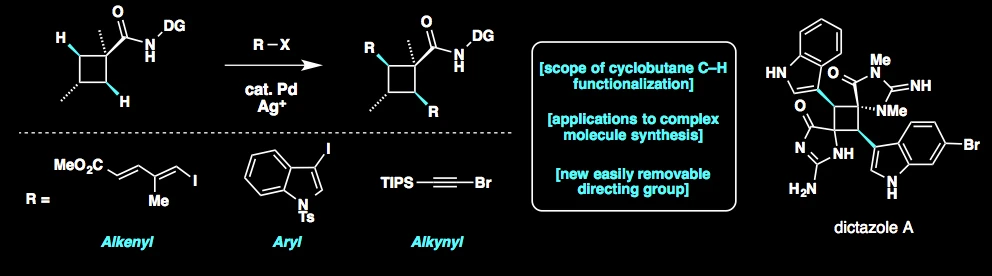
Will Gutekunst’s graduate work is one of the cleanest demonstrations that C–H functionalization logic is not only a way to oxidize a terpene. It can be the way you make the carbon skeleton itself. Photochemical [2+2] cycloadditions are the obvious route to cyclobutane natural products, and they are often unselective when the olefins are similar. Gutekunst’s alternative was to start with a simple cyclobutane and install the aryl groups one at a time, by directed C–H arylation.
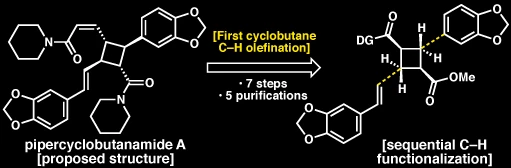
Gutekunst and Baran’s 2011 JACS paper is the total synthesis and structural revision of the piperarborenines “via sequential cyclobutane C–H arylation.” Two sequential sp3 C–H arylations on the same cyclobutane, under the control of a directing group, built piperarborenine B and led to a revision of the structure of piperarborenine D — a reminder that when you actually make the molecule, you sometimes find that nature, or the original assignment, had a different isomer in mind. The 2012 sequel, with Gianatassio, used a sequential C(sp3)–H arylation and olefination to reach the proposed structure of pipercyclobutanamide A. Gutekunst and Baran’s 2014 JOC paper, “Applications of C–H Functionalization Logic to Cyclobutane Synthesis,” is the full strategic account: why [2+2] logic struggles with unsymmetrical dimers such as the dictazoles and piperarborenines, and what role directing groups play when the ring is already there and the C–H bonds are the functional groups.
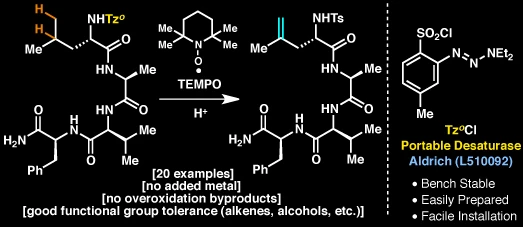
Guided logic also has a desaturation chapter. Voica, Mendoza, Gutekunst, Fraga and Baran’s 2012 Nature Chemistry paper, “Guided Desaturation of Unactivated Aliphatics,” is a way to introduce a double bond into an unactivated aliphatic setting under the influence of a directing group — an oxidase-phase move that is not an oxygenation at all, but still a C–H decision about where the molecule should become unsaturated.
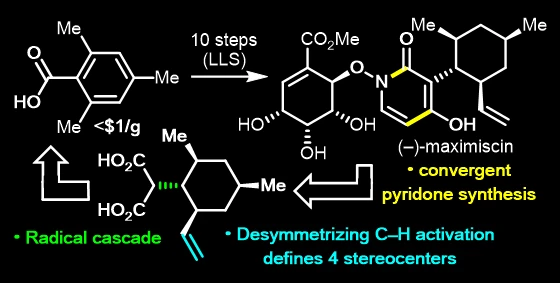
Maximiscin, a later target from a different graduate generation, is another standout C–H synthesis. McClymont, Wang, Minakar and Baran’s 2020 JACS paper is a 10-step (longest linear sequence) total synthesis of (−)-maximiscin. Among several unusual operations — a step that sets four stereocenters at once, a decarboxylative Giese reaction — the route includes a C–H activation sequence on an amide, used to forge a key C–C bond rather than to decorate a finished skeleton. It is the same planning habit as the piperarborenines: treat a C–H bond as the handle, and the step count collapses. (The paper’s own ideality audit counted the synthesis at 60% ideal over that 10-step longest linear sequence.)
Sulfinates are C–H logic
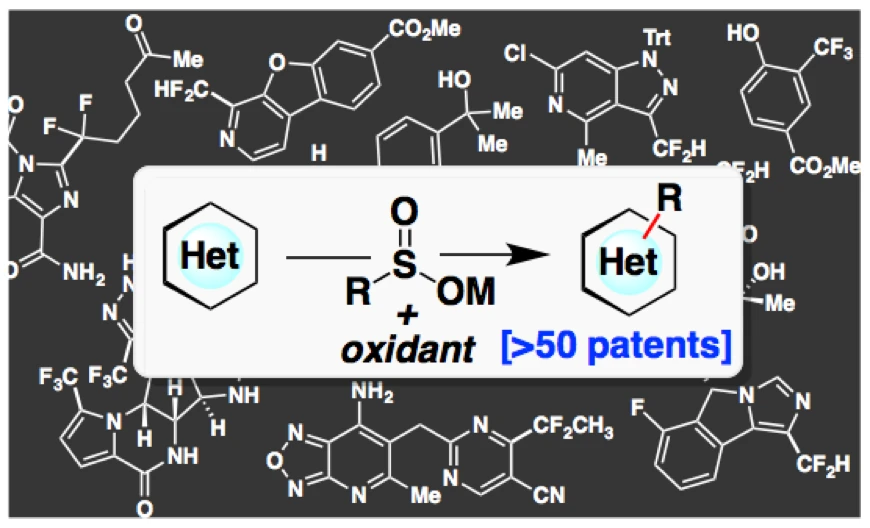
If two-phase terpene synthesis is C–H logic applied to a skeleton you built yourself, sulfinates are C–H logic applied to the molecules medicinal chemists already have. A heteroarene C–H bond, under innate electronic control, becomes a place to hang a CF3, a CF2H, an alkyl or an aryl group — without first installing a halide or a boronic acid. That is the same planning language as the 2012 Account, pointed at the largest body of practicing organic chemists.
The lineage starts before anyone called the reagents Diversinates. A 2010 borono-Minisci reaction already showed that electron-deficient heterocycles can be arylated directly at C–H with arylboronic acids. A 2011 paper extended practical C–H functionalization to quinones with the same class of reagents. Then the sulfinates arrive as a general radical source. Ji, Blackmond, Baran and co-workers’ 2011 PNAS paper, “Innate C–H trifluoromethylation of heterocycles,” turned the Langlois reagent (sodium trifluoromethanesulfinate) into a benchtop-stable, operationally simple trifluoromethylation of heteroarenes, with regioselectivity that can be tuned by solvent. In 2012, zinc difluoromethanesulfinate — DFMS, Zn(SO2CF2H)2 — became a new reagent for direct difluoromethylation of heteroarenes, thiols and enones. The same year brought zinc trifluoromethanesulfinate (TFMS) as part of a broader zinc-sulfinate family for innate heteroarene C–H functionalization, in the paper “Practical and innate carbon–hydrogen functionalization of heterocycles.” A 2013 Nature Protocols paper told a discovery chemist how to prepare and purify those zinc sulfinates, including TFMS and DFMS. MilliporeSigma would later sell a toolbox of them as Diversinates; the count is 40 distinct sulfinates.
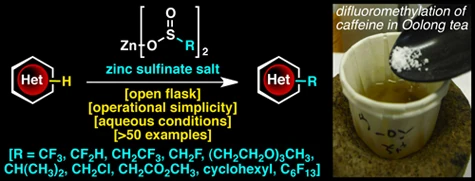
The family then fans out, still under C–H logic. A 2013 JACS paper mapped radical-based regioselectivity on electron-deficient heteroarenes. Native-chemical tagging of C–H bonds became a bioconjugation method the same year. A mild, ferrocene-catalyzed C–H imidation and a C–H methylation of heteroarenes inspired by radical SAM methyl transferases followed in 2014. Gianatassio, Kawamura, Eprile, Foo, Ge, Burns, Collins and Baran showed that an interrupted Barton decarboxylation converts ordinary carboxylic acids into sulfinate salts, including TFCS-Na, a trifluoromethylcyclopropyl sulfinate isolated in 75% yield and confirmed by X-ray. Caffeine took that salt to the trifluoromethylcyclopropane adduct in 71% yield in an hour (TBHP, diethyl carbonate/water, 90 °C). The paper prepared a panel of ten new sulfinates; six were field-tested on four classes of heterocycles, and several were made on multi-gram scale for commercialization. Classic Minisci conditions on the parent fluorinated acids gave little or no product. A Novartis-inspired bis-pyridine that had been reached in a 3% last-step Suzuki coupling was recast as a one-pot C–H trifluoromethylcyclopropanation / Suzuki sequence in 37% over two steps. It sits alongside Diversinates, zinc sulfinates, TFMS and DFMS as one of the lab’s sulfinate reagent papers. O’Brien and co-workers put radical C–H functionalization of heteroarenes under electrochemical control, a mechanistic and practical bridge to the lab’s electrochemical C–H work. Palau’chlor, a practical chlorinating reagent born of a natural-product problem, is a C–H chlorination method also discussed among the lab’s reagents. Smith, Dixon, deGruyter and Baran’s 2019 Journal of Medicinal Chemistry review, “Alkyl Sulfinates: Radical Precursors Enabling Drug Discovery,” surveys their adoption, with more than 50 examples from the patent and primary literature.
The reagents shelf
The sulfinate story is told at greater length, with vendor links and regioselectivity figures, in the lab’s reagents chapter. They are innate C–H functionalization logic, bottled.
C–H oxidation, and C–H logic elsewhere
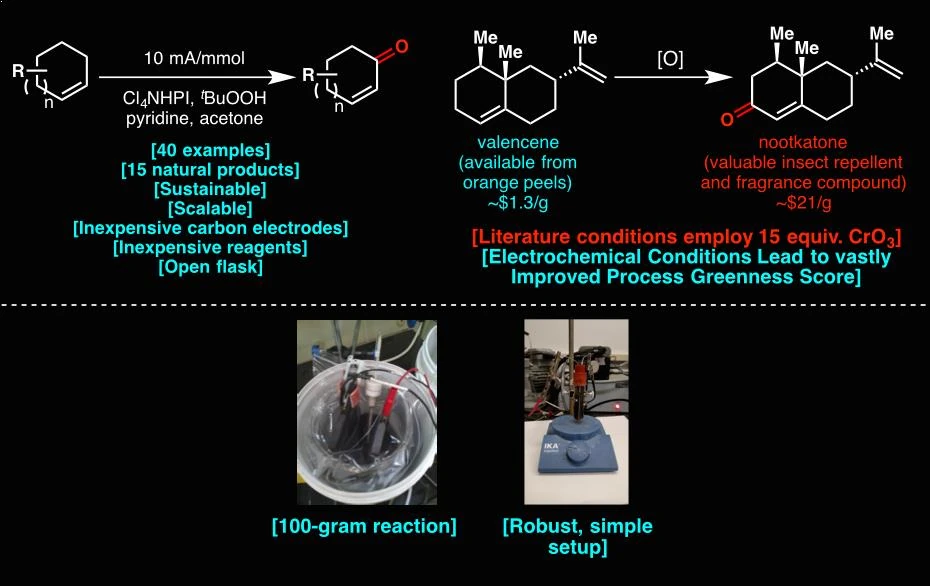
Electrochemistry gave the oxidase phase a new oxidant: the electrode, often with a simple mediator. In 2016, a scalable and sustainable electrochemical allylic C–H oxidation — developed with Bristol Myers Squibb — reached a 100-gram demonstration, as also described in the electrochemistry chapter. In 2017, quinuclidine-mediated electrochemical oxidation was extended to unactivated C–H bonds, including a 50-gram oxidation of sclareolide, going after “deep-seated” methylene and methine positions that chemical oxidants often miss. In 2021, N-ammonium ylides became a tunable family of electrochemically driven mediators for site-specific, chemoselective C(sp3)–H oxidation, designed to be made from ubiquitous building blocks and to cover ground that a single mediator such as quinuclidine cannot. The hardware and the rAP waveform are covered in the electrochemistry chapter. The logic here is which unactivated C–H bond to oxidize, and how to do it without tearing up the rest of the molecule.
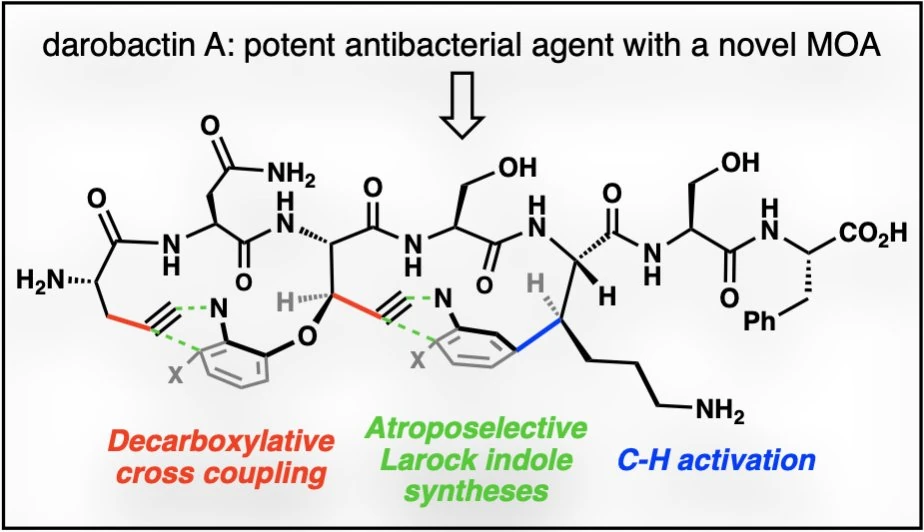
Once C–H functionalization logic is a habit, it shows up in syntheses that are not terpene campaigns. The 2015 total synthesis of verruculogen and fumitremorgin A was enabled by a ligand-controlled iridium-catalyzed C–H borylation, used to access the seemingly simple starting material 6-methoxytryptophan — a C–H decision at the first step, not the last. Peters, Romesberg and Baran’s 2018 arylomycin paper is even more explicit: “Scalable Access to Arylomycins via C–H Functionalization Logic,” built around a Cu-mediated oxidative phenol coupling that mimics the putative biosynthesis and closes, on gram scale, what the authors describe as the largest peptide macrocycle forged by that reaction. In 2024, biocatalytic C–H oxidation met radical cross-coupling to simplify complex piperidine synthesis, a collaboration that joins an enzymatic oxidase-phase move to the lab’s radical-coupling toolkit. A 2026 Nature Synthesis paper with the Engle group reports a chemoselective, nickel-catalysed, directed C(sp2)–H alkylation at low temperature using alkyl sulfonylhydrazides — guided C–H logic again, now with a hydrazide handle that also belongs to the cross-coupling page. The preceding ChemRxiv preprint describes the reaction at 50 °C, on both primary and complex secondary alkyl donors, with a scope of more than 70 examples; it is scalable and was applied in a natural-product setting. Sulfonylhydrazides generate alkyl radicals under milder conditions than the corresponding alkyl halides: a pyridine example that gave 67% isolated yield gave none with the alkyl iodide under previously published conditions. Computation and experiment point to an asynchronous, amine-assisted C–H activation pathway.
Taken together, these papers are one research program, not a pile of oxidation methods. The 2011 review and the 2012 Account gave it a language. Two-phase terpene synthesis gave it a campaign, from eudesmanes to Taxol, ingenol and phorbol. Sulfinates gave it a bottle that a medicinal chemist could pick up on a Tuesday. Gutekunst’s cyclobutanes and the maximiscin synthesis gave it total-synthesis scenes in which the C–H bond is not a late decoration but the keystone. And the short paper with Albert Eschenmoser still makes the point: even the subtle rate ratios of equatorial and axial C–H bonds are worth understanding, if the goal is to plan a synthesis as if those bonds could talk.

 The logicThinking in radicals
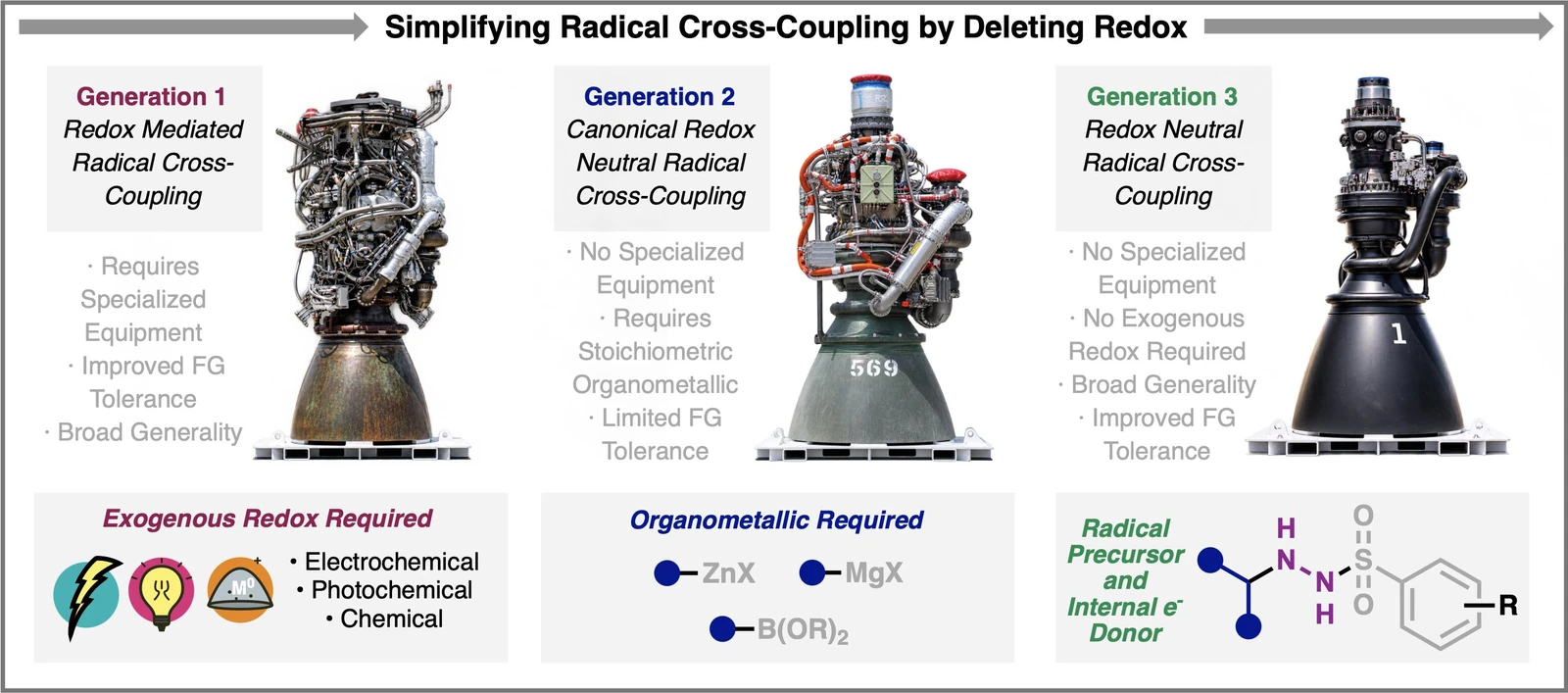 Cross-couplingDeleting redox
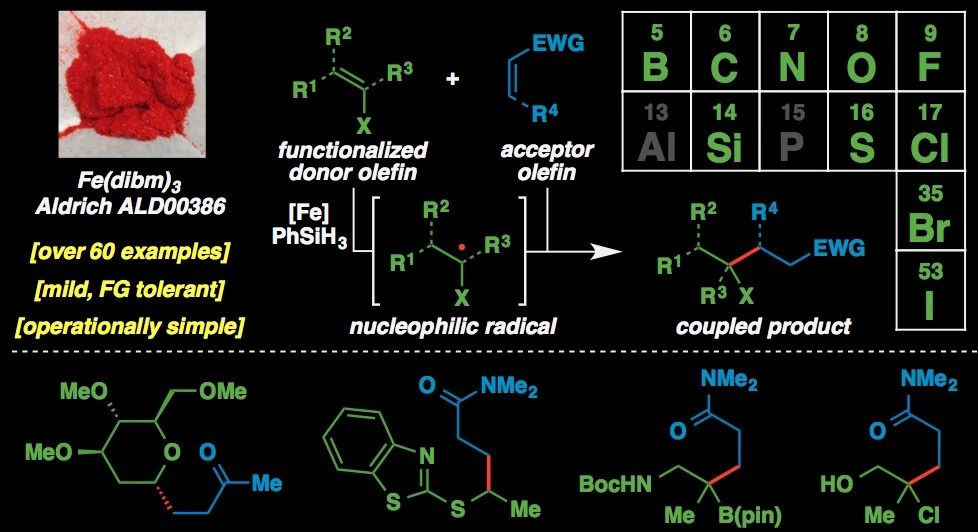 Olefins / MHATOlefins as radicals
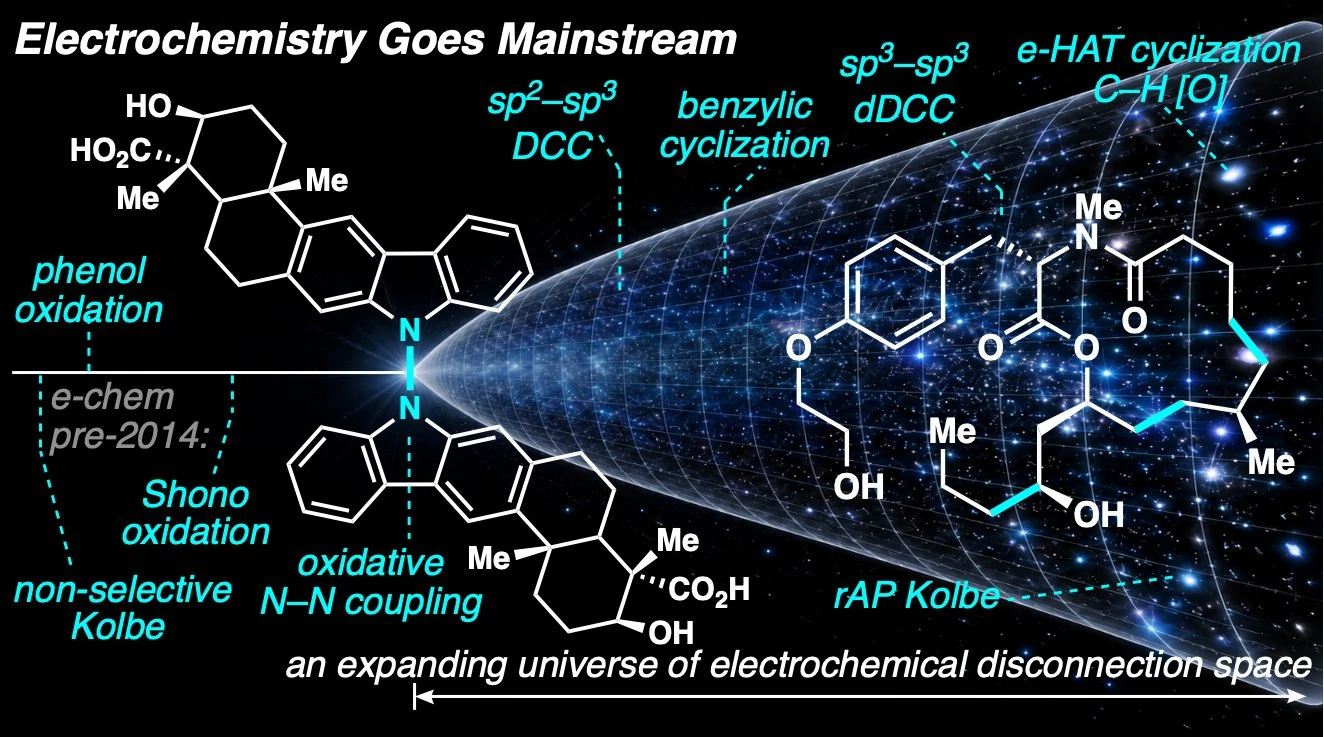 ElectrochemistryThe electron as a reagent
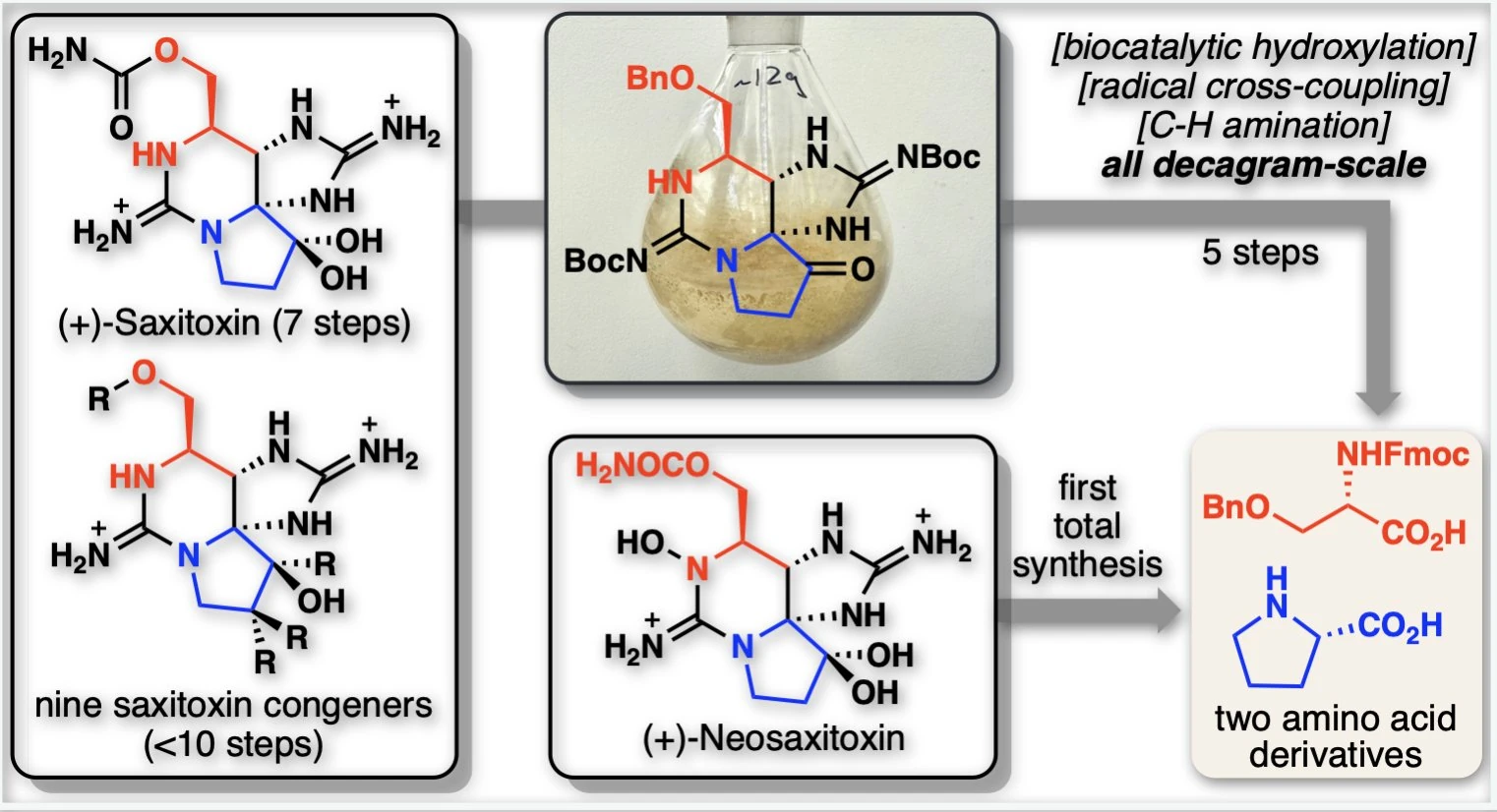 Total synthesisProving ground
 ReagentsReagents in a bottle
 OligonucleotidesRewriting the backbone
 PeptidesRewriting the peptide